China’s military hydration-bag suppliers serve buyers who need more than a reservoir and a drinking tube. A pack must sit securely against a load-bearing vest, resist abrasion, and let users drink without awkward handling. Small details matter: a protected bite valve, reachable hose routing, and seams that stay dry after repeated field use.
Grand View Research’s Hydration Backpack Market report provides useful context on the wider category, including market trends and product demand. It does not, however, isolate military procurement from recreational products. That distinction matters. A growing consumer market does not, by itself, prove that a factory can meet military-grade testing, documentation, or production requirements.
CamelBak founder Michael Eidson helped popularize hands-free hydration. A fair paraphrase of the design principle behind his early concept is: “Water should stay accessible while movement continues.” That is a guiding idea, not a verified verbatim quotation. In practice, it raises concrete questions for Chinese manufacturers: What materials are used? How are leak resistance and capacity checked? Can the supplier provide traceable test records and consistent samples?
This comparison will examine those questions alongside product design, manufacturing capability, customization, and export experience. Specifications can look convincing on a screen. They still need verification. Buyers should compare documented test methods and inspect samples before treating a supplier’s claims as established performance.
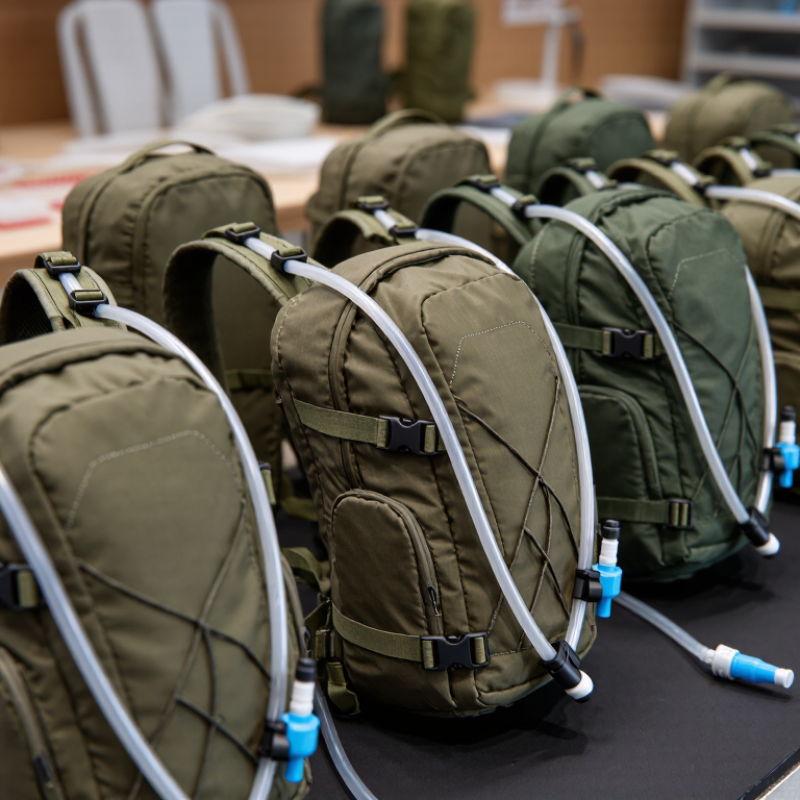
What Defines a Military Hydration Bag and Its Core Requirements?
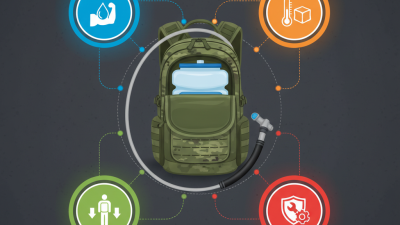
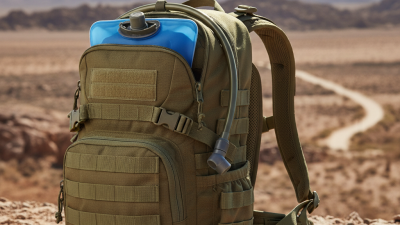
A military hydration bag is a hands-free water system designed to stay secure during movement and provide reliable access in the field. Its core components are a reservoir, drinking tube, bite valve, and carrying system. Reliability matters: a leaking seam or blocked valve can turn a useful tool into dead weight. The reservoir should be easy to inspect and clean, while the tube should route neatly without snagging on straps or equipment. Capacity must match the task, climate, and refill opportunities; bigger is not always better.
Water needs vary with heat, workload, and the individual. The National Academies’ Dietary Reference Intakes (2005) set adequate total-water intakes at 3.7 liters daily for men and 2.7 liters for women, including water from food and all drinks. These figures are population references, not field prescriptions. NIOSH’s heat-stress guidance recommends about one cup of water every 15–20 minutes during moderate work in heat, with intake generally not exceeding 48 ounces per hour. A hydration bag supports access, but it does not guarantee safe hydration.
Tips: Check for leaks before use. Sip regularly, and clean and dry the reservoir after each outing. Test the valve with gloves on. Small details matter. In practice, fit and cleaning are sometimes overlooked; a technically sound bag can still be uncomfortable or unhygienic if it is hard to maintain.

Common Hydration Reservoir Capacities
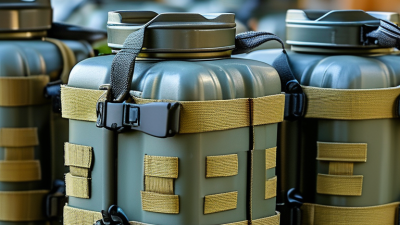
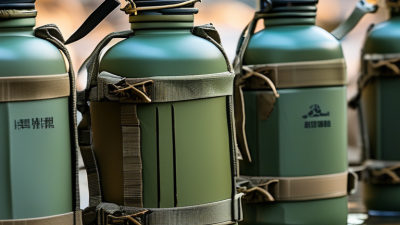
Reservoirs commonly come in 1.5 L, 2 L, and 3 L capacities. These are representative product sizes, not official military requirements. A practical military hydration bag also needs a leak-resistant reservoir and closure, a secure drinking tube and bite valve, durable construction, and a design that is easy to clean.
China’s military hydration bag industry developed alongside its technical-textile and outdoor-equipment manufacturing base. Early production focused largely on basic reservoirs and assembly. Over time, workshops adopted heat-welded seams, molded fittings, and more structured leak checks. The change was practical. A reservoir must remain sealed inside a pack, while its drinking tube stays accessible during movement. Local access to coated fabrics, plastic components, and tooling also helped shorten prototype cycles. Still, a nearby supply chain does not guarantee reliable field performance.
Manufacturers gradually expanded from simple bladders to complete systems, including insulated sleeves, tube clips, and replaceable bite valves. Quality checks may examine pressure resistance, seam strength, material odor, cleaning access, and performance after repeated filling. Small details matter: residue can collect in narrow corners, while a stiff tube can be awkward to handle with gloves. More demanding customers have also encouraged clearer material records and consistent inspection between production batches. Progress remains uneven. Some designs still favor lower cost over easier maintenance, a trade-off worth examining. Buyers can ask for test methods, batch records, and samples assessed under realistic temperature and handling conditions.
China’s military hydration-bag manufacturers are best compared by production specialty, not catalogue claims. Cut-and-sew suppliers focus on durable shell fabrics, reinforced seams, and modular pocket layouts. Reservoir specialists prioritize flexible liners, leak testing, bite valves, and replaceable tubes. Some factories offer both, but verify this with samples and test records. Details matter.
Textile Exchange’s Materials Market Report 2024 estimates global fiber production reached 124 million tonnes in 2023, with polyester accounting for 57%.
This helps explain the range of shell-fabric options available from Chinese suppliers; it does not prove a bag’s durability. Request fabric weight, abrasion results, seam-weld records, and repeated fill-and-drain test data. For hot, dusty use, inspect zipper covers, tube routing, and how the reservoir rests against the back. A small flaw can matter. Replacement-valve availability is also worth checking, though product listings often leave it unclear. Compare equal capacities and test conditions, since liters alone do not show fit or load stability.
Military hydration bags depend on more than a tough-looking fabric. The bladder commonly uses food-contact-grade TPU, selected for flexibility and resistance to repeated folding. Outer carriers may use woven nylon, with reinforced stitching at strap anchors and corners. Material certificates help verify composition, but they do not replace testing of the finished product.
Manufacturing details matter. RF welding can create consistent bladder seams, while controlled heat and pressure reduce weak spots. Workers should inspect weld lines for wrinkles, gaps, and trapped debris. Bite valves and hose connections need fit checks, followed by leak testing under pressure. Small defects can become obvious after a bag is filled and carried.
Quality checks should reflect the intended use and applicable requirements. Useful tests include seam strength, abrasion resistance, temperature cycling, and checks for substances that could migrate into drinking water. Records should connect test results to material batches and production dates. A clean inspection sheet is reassuring, but not proof by itself. Some factories still rely too heavily on visual checks; that deserves scrutiny. A practical supplier can explain its sampling rate, corrective-action process, and how rejected units are handled.
Practical sourcing and evaluation reference for military-style hydration bags. Material choices, dimensions, test limits, and regulatory obligations vary by design and destination market; confirm them in the product specification and test plan.
| Evaluation area | Typical materials or process | What to verify | Relevant reference |
|---|---|---|---|
| Reservoir film | Thermoplastic polyurethane (TPU) is commonly selected for flexible, weldable reservoirs. Polyethylene-based films are another possible design option. | Request the exact resin and film specification, thickness tolerance, intended water-contact use, and applicable migration or chemical-compliance documents. Do not assume all TPU grades have the same properties. | EU Regulations (EC) No 1935/2004 and, where applicable to plastic food-contact materials, (EU) No 10/2011. |
| Reservoir seams | Radio-frequency (RF) or high-frequency welding is used for compatible thermoplastic films; process selection depends on the material and construction. | Inspect seam continuity and alignment. Define leak, peel, burst, and repeated-flex tests with agreed methods and acceptance limits; validate settings after material or tooling changes. | Use a documented, product-specific test plan. There is no single universal seam-strength limit for all hydration reservoirs. |
| Protective carrier and pack body | Woven nylon or polyester fabrics may be used, with coatings or laminations selected for the required abrasion and water-resistance performance. Denier and coating vary by design. | Check fabric identity, weight, color consistency, coating adhesion, seam construction, abrasion performance, and compatibility with the intended cleaning and field-use conditions. | ASTM D751 includes test methods for coated fabrics; select the applicable methods and acceptance criteria for the construction. |
| Tube, bite valve, and fittings | Tubing may be made from materials such as TPU or PVC; valve bodies and connectors may use molded polymers, with elastomeric seals where required. | Confirm the material grade for every water-contact part. Test connection retention, flow, valve closure, leakage, kink resistance, and cleaning access. Check chemical compliance for the target market. | REACH Regulation (EC) No 1907/2006 may be relevant to chemical restrictions and substance communication; applicability depends on the product and market. |
| Cutting and assembly | Typical operations include film cutting, welding, tube and valve assembly, carrier sewing, and final cleaning and packing. | Review controlled work instructions, equipment maintenance, operator training, lot identification, in-process inspection, and records linking finished goods to material batches. | ISO 9001 specifies requirements for a quality management system; it is not a product-performance certification. |
| Leak and functional inspection | Finished reservoirs can be checked using a defined water-fill, pressure, or other validated leak-test procedure; test method should match the product design. | Agree sampling frequency and pass/fail criteria before production. Record leaks, valve failures, and rework by lot, and verify that corrective actions are effective. | ISO 2859-1 provides attribute-sampling procedures indexed by acceptance quality limit (AQL); an AQL is a sampling-plan parameter, not a guarantee that every unit is defect-free. |
| Environmental durability | Performance depends on the complete assembly, including film, seams, closures, tube, carrier, and fittings. | Specify the expected temperature, humidity, handling, storage, and transport conditions. Test representative finished samples and inspect for leaks, cracking, deformation, and loss of function. | MIL-STD-810H contains environmental engineering and laboratory test methods. Select and tailor methods to the intended use; it is not a blanket product certification. |
| Supplier qualification | Assess manufacturing capability, material sourcing, inspection controls, traceability, and change management rather than relying on a material list alone. | Request current audit evidence where available, material declarations, test reports for the offered construction, sample approval records, and written notification procedures for changes to materials or processes. | Verify certificate scope, issuing body, site, and validity directly; management-system certification does not by itself demonstrate hydration-bag safety or durability. |
Choosing a Chinese hydration-bag manufacturer takes more than comparing catalog photos. Check the reservoir material, welded seams, hose fittings, and bite-valve design against your use conditions. Ask for written leak-test procedures and recent quality records, not just verbal assurances. The Outdoor Industry Association’s 2024 Outdoor Participation Trends Report estimated that 175.8 million Americans took part in outdoor recreation in 2023, or 57.3% of the population. That signals a broad market, not proof that any supplier makes dependable equipment. Numbers help. Not enough.
Request a production sample and inspect the details yourself. Fill the reservoir, close the cap, and leave it overnight on a dry surface. Check for damp seams, plastic odor, and valves that drip after repeated use. Ask how the factory tracks material batches and handles failed inspections. Compare sample quality with the unit made during a trial run; small changes can slip through. Test the real unit. A factory audit, clear specifications, and documented corrective actions offer stronger evidence than a polished showroom. Some buyers focus too heavily on price. That is easy to regret when stitching, fit, or cleaning access disappoints in daily use. Verify lead times, minimum order quantities, and what happens when a component changes.